The operating system for the world’s drone industry.
We give nations and manufacturers the infrastructure to create, produce, and continuously advance their own drone fleets.
Our mission is a global network of drone industries, building locally and operating at scale. Odeon connects the capability, from the first blueprint to the factory floor and the field.
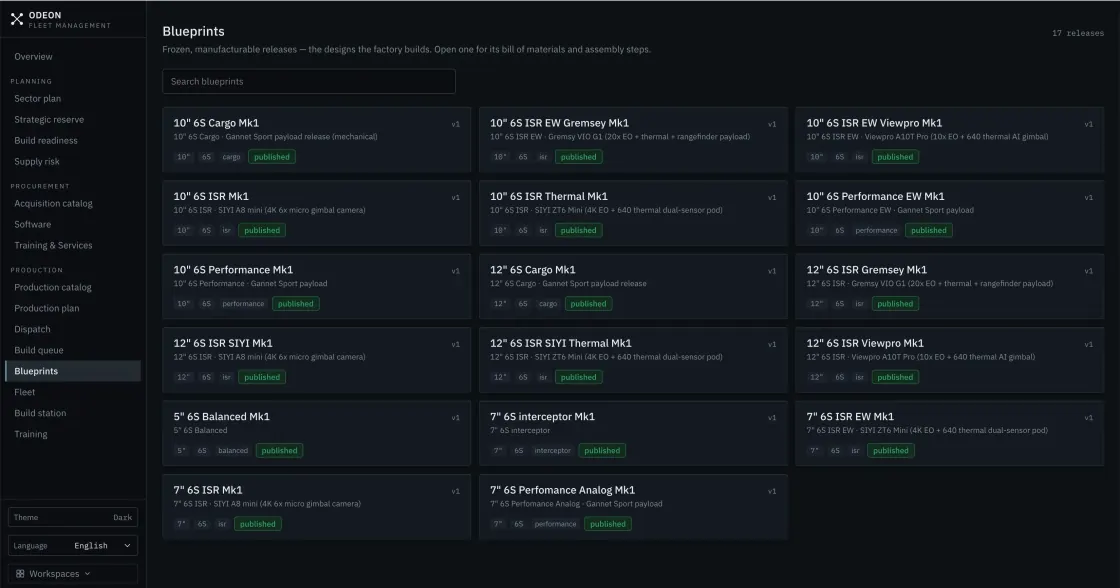
Software to design drones, source the parts, and manage production.
Odeon connects an AI engineering tool to combat-proven blueprints, tested component data, and physics simulation. Your team can adapt designs, compare parts, and evaluate changes before building.
The same platform supports sourcing, manufacturing, and field operations, keeping the people building drones connected to those using them.
Use our managed platform or deploy a dedicated local instance. Our experts help establish your starting blueprints, set up the platform, and train your team.
Military requirements change. Your capability must keep advancing.
Military organizations need affordable drones in volume, with designs that can adapt as field requirements and component availability change.
Odeon helps establish that continuing capability: engineers who can revise designs, manufacturers who can maintain output, and field teams whose experience informs what comes next.
Specialized designs. A common foundation.
Different missions and operating environments call for different aircraft. A handful of general-purpose models can leave teams working around the same compromises.
Odeon helps you develop a family of designs around your requirements. Each blueprint serves a clear purpose, with shared components and interoperability considered across the portfolio.
Multiple manufacturers can build from that common foundation. You gain a broader mix of capabilities while keeping sourcing, maintenance, and production manageable.
One platform, from the first design to the next generation.
Run the complete process with your own team or work with manufacturing partners.
Design your drone
Start with a combat-proven blueprint or co-develop with our experts. Use the AI engineering tools, component catalogue, and simulation environment to adapt it to your requirements.
Order the parts
Source components through the Odeon marketplace or buy directly from third-party suppliers, using the design’s bill of materials and your sourcing requirements.
Choose how to build
Through a manufacturer: Share the blueprints, bill of materials, and build documentation with your manufacturing partner.
With your own team: Use Odeon’s assembly instructions and production tools to build locally, with teams as small as one person or across multiple sites.
Put the drones into service
Deliver completed aircraft to your field teams. Odeon’s field and mission-planning tools support the people operating them.
Bring experience back into engineering
Collect pilot feedback and feed it into the next blueprint revision. Evaluate changes, update the design, and start the cycle again.
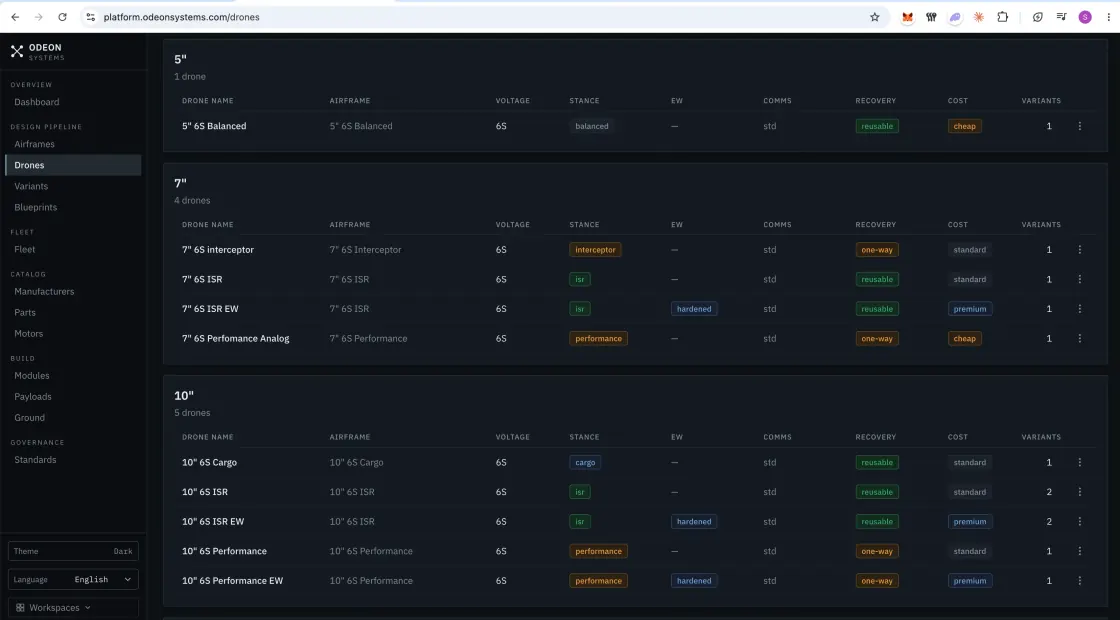
Combat-proven blueprints are the starting point.
Begin with operationally proven designs and the documentation to build them. Each blueprint specifies the components, assembly instructions, and software configuration.
Our experts help adapt that foundation to your program.
Define your starting portfolio
During onboarding, we establish your baseline blueprints and engineering strategy around your requirements, manufacturing capability, and sourcing constraints.
Co-develop with our experts
Odeon works alongside your engineers to adapt existing blueprints and develop new designs where your program needs them.
Establish your own development process
Your team learns to assess changes, evaluate alternatives, and maintain the designs you produce.
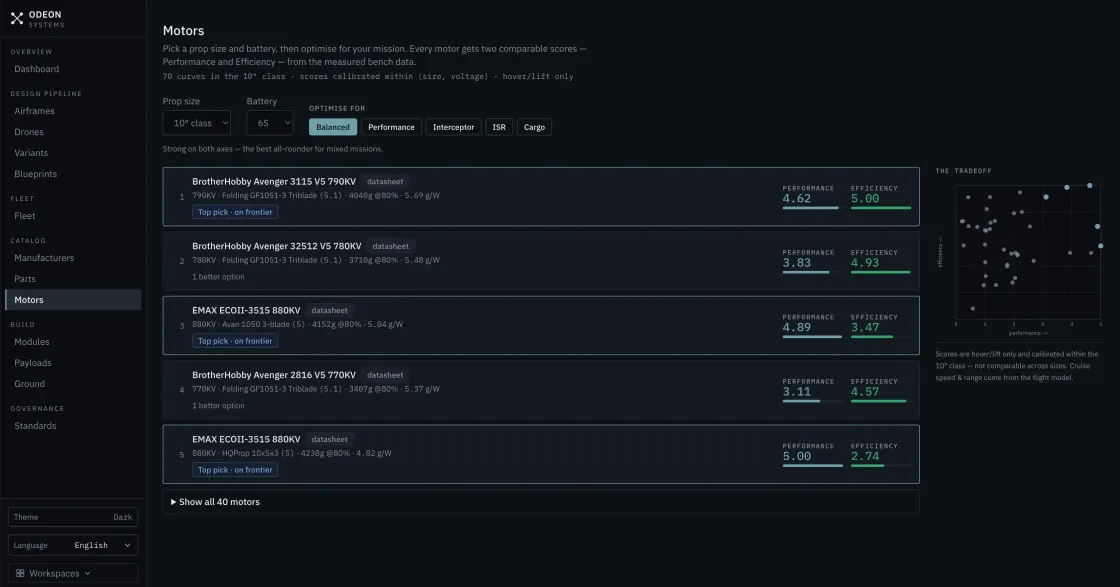
Dependable engineering begins with dependable component data.
Our proprietary catalogue combines detailed specifications, performance measurements, and high-resolution CAD files.
Engineers and the AI model use the same records, connecting design decisions to actual parts.
Tested by Odeon
Our testing adds measured performance data to supplier specifications, giving your team a stronger basis for component selection.
Detailed enough to design with
Dimensions, engineering specifications, performance metrics, and CAD assets support design work within the platform.
Clear about the evidence
Records distinguish supplier declarations, Odeon measurements, and third-party determinations.
Maintained as the market changes
New components and updated data become available for assessment against your existing designs.
A custom AI model that works inside the engineering process.
Odeon’s model is post-trained for drone engineering and its military context. Its knowledge covers technical documentation, field-derived experience, relevant doctrine, production, and inventory considerations.
Work from your requirements
Explore design options with component choices, sourcing restrictions, and program requirements built into the process.
Use the engineering environment
The model works with component records and blueprints, and runs analysis through Odeon’s physics and simulation engine.
Assess changes to existing designs
Identify alternatives when requirements or components change, and understand their implications for the blueprint.
Your engineers direct the work, inspect the results, and approve changes.
Put proposed designs through physics and simulation.
Odeon’s physics engine lets engineers evaluate proposals before committing to a physical build.
Engineers and the AI model can run performance analysis and computational fluid dynamics simulations within the platform.
Evaluate performance
Analyze designs using their geometry and component data.
Compare proposed changes
Assess alternative configurations and component substitutions through a consistent simulation process.
Review the results
Inspect the analysis behind a proposal and use it to guide the next revision.
Start with your blueprint and the parts you have.
A small forward-deployed unit can assess changes to an existing design using components already in stock. Every user gets engineering support without needing to become a CAD or simulation specialist.
Your team brings the blueprint, available parts, and required change. Odeon checks compatibility and integration requirements, highlighting conflicts and anything that needs further review.
Small teams get clear guidance on their options. Engineering teams can work through detailed analysis and complex development in the same environment.
Your supply chain is part of the design.
Domestic manufacturing depends on a global component market. Odeon connects design decisions to your sourcing rules, supplier relationships, and purchasing needs.
Design around national and program requirements
Specify permitted countries of origin, approved manufacturers, restricted suppliers, and minimum domestic spending.
Set the percentage of component spend that must stay in-country, with different origin rules by component category. Include sourcing criteria that support procurement pathways such as Blue UAS.
The AI uses these constraints when developing proposals and recommending parts.
One order, many suppliers
Odeon manages supplier relationships and coordinates procurement across different lead times, minimum orders, and purchasing processes.
Our marketplace connects your blueprints to sourcing support and consolidated purchasing.
Provenance you can inspect
Component records identify manufacturers, origins, and evidence supporting specifications and procurement status. Engineering and purchasing teams use the same information.
Alternatives qualified before you need them
We qualify alternatives ahead of shortages and end-of-life changes, assessing them against the parts they replace.
When availability changes, the AI helps find candidates that meet sourcing rules and minimize blueprint changes. Engineers evaluate substitutions before approving them for production.
Purchasing discretion built in
Order volumes can reveal a program’s scale. Odeon aggregates procurement so suppliers see our combined demand rather than your individual purchasing.
Affordable drones. Repeatable production. Industrial scale.
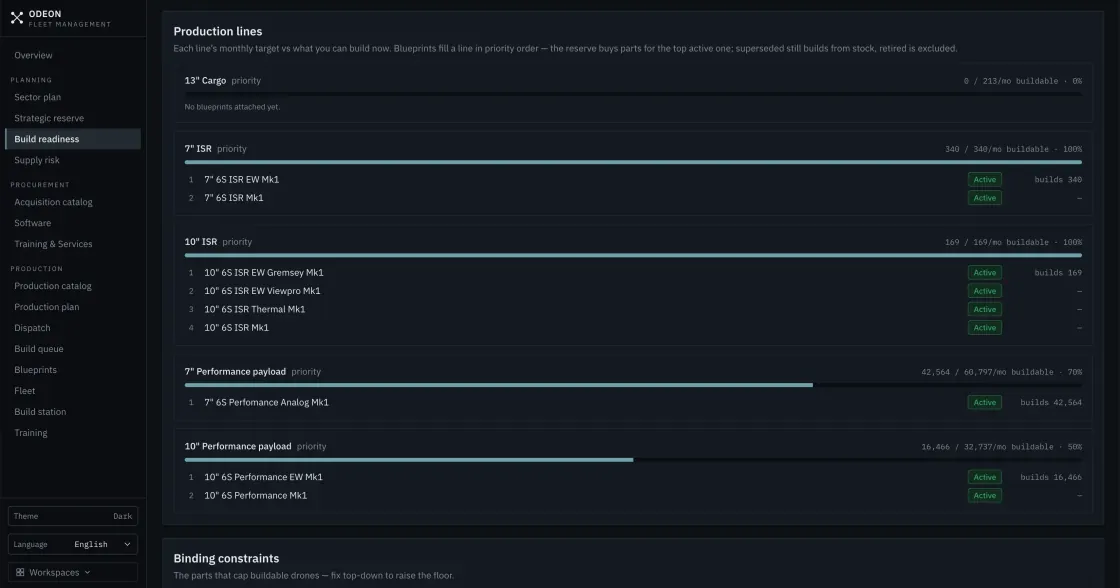
A design’s value depends on your ability to manufacture it consistently and affordably.
Odeon connects approved blueprints, component selections, build instructions, and production readiness across workers and sites.
Keep engineering connected to the line
Approved revisions flow into the documentation and component information manufacturing teams use.
Keep cost in view
Assess design changes against component costs and sourcing requirements.
Expand with a consistent process
Common build documentation and workflows help increase output while maintaining quality.
Improve without losing control of production
AI accelerates proposed changes. Engineers approve them before they enter manufacturing.
The next revision starts with experience in the field.
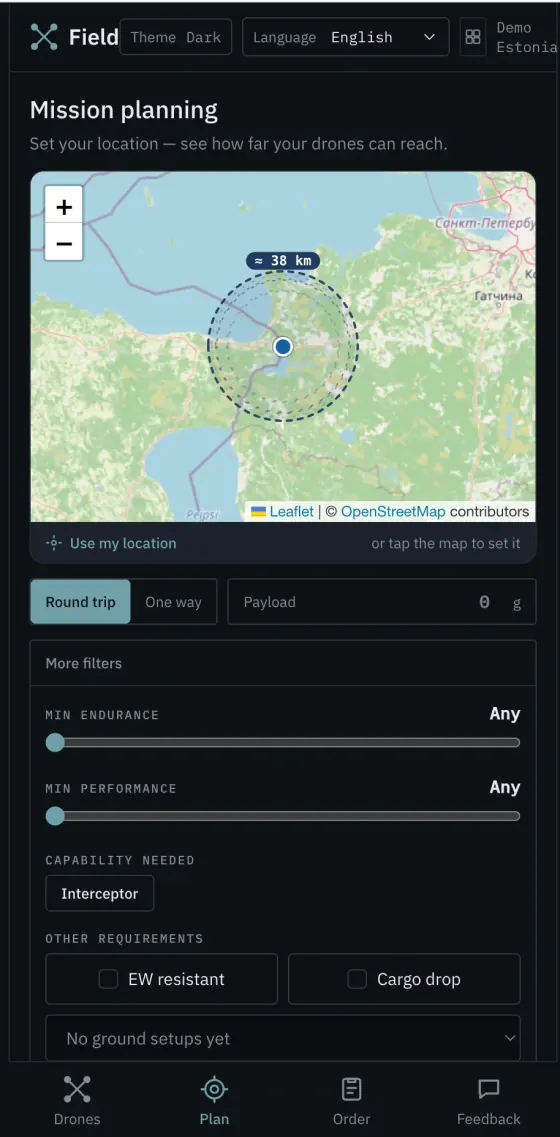
Odeon’s field and mission-planning tools support operators and connect their experience to engineering.
Requirements and feedback inform blueprint revisions, keeping development tied to how systems are used.
We continue developing these capabilities, including specialized AI models for field and planning workflows.
Shared access or sovereign deployment. Choose the right fit.
Both options include expert onboarding and access to Odeon’s engineering environment.
Managed shared access
The capability without the infrastructure overhead.
Use our engineering tools, specialized AI, and proprietary catalogue through a managed platform. Odeon operates the infrastructure and manages updates.
Divisions, special forces units, manufacturers, and engineering teams can get started without maintaining dedicated compute.
Your private work stays within your organization.
Customer workspaces remain isolated. Other clients cannot access your designs, requirements, files, or conversations. Using the shared catalogue does not expose your private work.
Dedicated sovereign deployment
A dedicated environment on infrastructure you control.
Deploy Odeon locally on H100-based infrastructure, including our custom model and engineering environment.
Quarterly updates deliver model improvements and updated engineering knowledge. Hosting, access, integration, and support arrangements reflect your program’s requirements.
A platform for the organizations building drone capability.
National programs
Establish domestic engineering and manufacturing capacity, with national sourcing requirements built into development.
Electronics manufacturers
Expand into drone production with blueprints, engineering tools, component knowledge, and hands-on implementation support.
Drone manufacturers
Accelerate development across existing products, connecting component selection, simulation, and design revisions to production.
We help put the capability into operation.
Every engagement starts with your requirements and an implementation plan.
Our program leads, engineers, and experienced field specialists work alongside your team, combining software with consulting, training, and technical support.
Define the program
Agree on objectives, starting blueprints, sourcing requirements, and deployment.
Establish the engineering foundation
Specify baseline designs and co-develop where needed. Set up the catalogue, tools, and engineering processes.
Connect the operation
Establish production workflows and relevant field tools. Train engineers, manufacturing teams, and operators.
Support continued development
Continue improving with expert assistance, training, catalogue development, and platform and model updates.
Trust is part of the foundation.
Control that fits your program
Choose shared access or dedicated local deployment, with infrastructure and access arrangements suited to your organization.
Evidence behind engineering decisions
Component provenance, Odeon test data, and simulation results make the basis for decisions inspectable.
Experienced people
Our team combines defense, engineering, and technology experience, including work in the field. Leadership details and references are available to qualified parties.
Capital integrity
We accept no adversary capital. Not directly, not through a fund, not at one remove.
Detailed capability, security, deployment, and commercial information is shared directly with qualified organizations.
Build your drone capability.
Tell us what you need to engineer, manufacture, or bring into operation.
We’ll develop an approach around your team, infrastructure, and production objectives.